
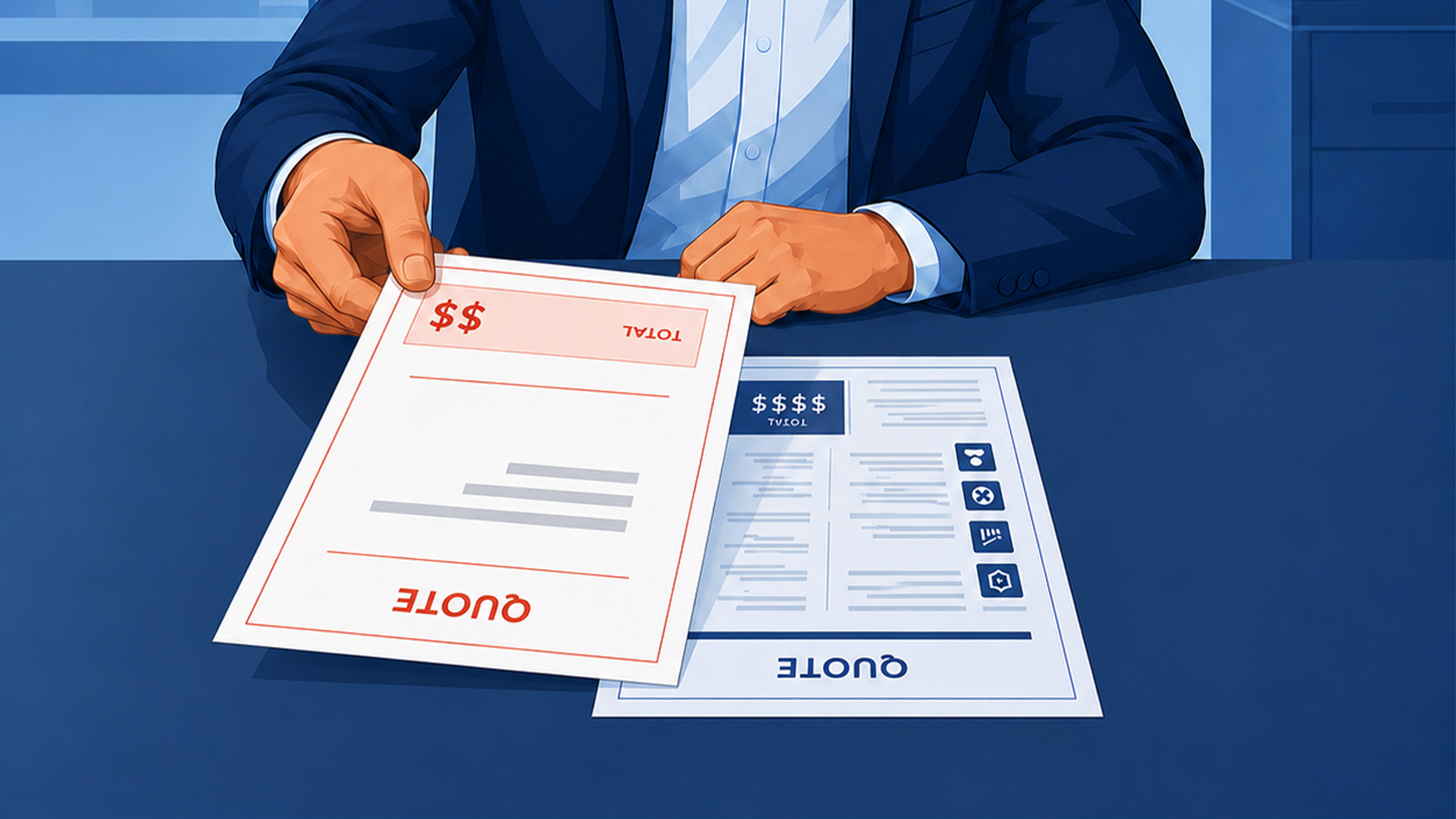
When two managed services providers quote on the same job and one costs significantly less, most business owners choose the lower number. The scope looks identical on paper, the promises sound the same, and the savings feel real. The problem is that what gets cut to hit that price point is rarely visible in the proposal.
The gaps rarely show up immediately either. Bad IT work does not fail dramatically. It does not send an error message or trigger an alarm but sits quietly in the background, creating conditions for something worse, and the problems surface when there is no good time to deal with them.
What “done” looks like from the outside
A network migration looks finished when staff can log in and files are accessible. A server setup looks finished when email flows and the shared drive appears. A security rollout looks finished when the antivirus icon shows green. But none of that tells you whether the work underneath is sound.
What is actually missing in low-cost jobs is the part the client cannot see: proper documentation of what was configured and why; licensing that is legitimate and registered to the correct account; security settings that are consistent rather than left at defaults; handover notes that mean someone else can pick up where the last person left off. Those are the things a qualified provider has to reconstruct when they come in afterward, and reconstruction is slower and more expensive than doing it right the first time.
What gets quietly cut
Cheaper providers do not always deliver less visibly. Sometimes the cuts are in areas most business owners would never think to check.
Fake cybersecurity
Many budget providers claim to manage security but install nothing more than consumer-grade antivirus software, then bill it as a managed security service. What that label usually implies – patch management, active threat detection, and a Security Operations Center monitoring your environment around the clock – is absent. The antivirus icon still shows green, and the dashboard still looks healthy, but the actual protection is closer to what you could install yourself for free, and the gap between that and genuine managed security is where most successful attacks find their way in.
Call centers or unqualified help desks
Deeply discounted managed services keep their margins workable by buying the cheapest labor they can find, and cheap labor is cheap for a reason. The issue is not where someone sits but whether they are qualified, properly trained, and given the authority to actually solve your problem. A discount provider staffs its help desk to a price point, which means scripted troubleshooting that works fine for password resets and stalls badly on anything complex. Tickets get escalated repeatedly without resolution, and the people your staff reach rarely have the context or the permission to fix the underlying issue. The cost to your business is not just the IT problem itself but also the hours your staff spend waiting for it to be resolved.
Talent is global, and any provider limiting itself to who happens to live within driving distance is choosing from a smaller pool than it should. Borked PC hires the most qualified person for the role regardless of where they are, with our Security Operations Center based in Colorado and skilled technicians both local and international, which is also how we support clients across multiple regions. The distinction that matters is not a map. It is whether the provider hired for skill or hired for cost, and whether the person answering your ticket has the training and the authority to close it.
When you compare quotes, ask who will actually be handling your tickets, what their qualifications are, and what they are empowered to resolve without escalation. Those answers tell you far more than a location ever will.
No strategic guidance
A reputable managed services provider includes virtual Chief Information Officer (vCIO) services as part of the relationship. A vCIO reviews your IT infrastructure on a regular cycle, flags equipment that is aging toward failure, identifies gaps before they become incidents, and builds a roadmap that keeps your technology aligned with where your business is going. Cheaper providers do not offer this, and without it your infrastructure ages without anyone noticing until something breaks, your software stack drifts out of alignment with your workflows, and every technology decision gets made reactively rather than planned in advance.
Where the money actually goes
The cost of remediating poor IT work typically falls into three categories. The first is diagnosis: a qualified technician inheriting someone else’s undocumented setup has to figure out what was done before they can fix it, and that process takes time that would not have been spent at all if the original work had been documented. The second is rework, because configurations that were set up incorrectly do not get patched; they get rebuilt. The third is exposure: if the original work left security gaps that were present for months before anyone noticed, the business has been operating at risk the entire time, and if something went wrong during that window, the cost extends well beyond IT remediation.
When you add diagnosis, rework, and any exposure costs to the original cheap quote, the total almost always exceeds what the second quote would have cost.
What to ask before you sign
If you are comparing quotes, the price difference is worth interrogating rather than celebrating. Ask what is included in the handover documentation. Ask how licensing is handled and who it is registered to. Ask what security stack is actually deployed and whether it includes active monitoring. Ask whether strategic planning and road-mapping are part of the engagement. A provider who cannot answer those questions clearly is not offering you a cheaper version of the same outcome; they are offering a different outcome at a lower entry price.
You never actually saved the money. You deferred the bill and added interest.
Let's talk about your IT setup
Most owners compare two quotes and look for what is the same. That is backwards. The two proposals are not the same job at two prices. They are two different jobs, and only one of them ends with a system somebody else can safely inherit.
Here is what makes cheap IT so dangerous. It does not fail loudly. There is no alarm. The green icon still says you are protected while the actual protection was never installed. You find out during the incident, which is the worst possible moment to learn what you bought.
Take five minutes today. Email your current provider one question: "What security stack is deployed on our network, and is it actively monitored?" Then watch how long the answer takes and how specific it is.
A vague answer is an answer.
👉 New to Borked PC? Start by filling out our quick Right Fit Questionnaire to see if Borked PC could be the right IT and Cybersecurity Partner for you.
📞 Or schedule a free 15-minute call at a time that works for you: Book a call
Prefer to talk now? Give us a call at (610) 599-6195.